Aye Write! 2021

The email asked if I would be interested in taking part in this year’s Aye Write! book festival, to talk about My Heart’s Content. I read it three times to be sure.

What you grinning at? Paul asked. I read him the email.

Well are you interested? he said. I nodded vigorously and asked if he wanted a cup of tea. He raised an eyebrow.

I’m playing it cool, I said. Don’t want to appear too eager.

Half way to the kitchen, which in our flat is around 10 steps, my coolness, such as it is, dissipated and I rushed back to send my reply, fully expecting to see a message telling me my window for responding had expired and I’d missed the opportunity. Or dreamed it.

Let me set my excitement in context. For those of you who aren’t aware, Aye Write! is Glasgow’s annual book festival. As with the city in which it’s based, it is big, bold and friendly. And this year, it was online, which means you could buy a pass for the whole festival and watch at your convenience.

There were sessions about dealing with grief, and the healing power of nature. Rock stars talked about memoirs and authors talked about fiction being the new rock n roll. There were authors talking politics and politicians, including Scotland’s First Minister Nicola Sturgeon, talking books.

Participating authors included big hitters Andrew O’Hagan, Douglas Stuart and Maggie O’Farrell, alongside those less well known but equally brilliant, such as Helen McClory, Ruth Thomas and Jenni Fagan. And there were those just starting out, like me!
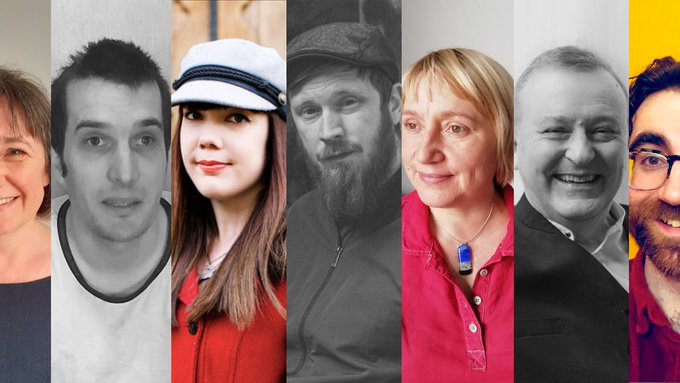
Scottish Debuts: Aye Write! Festival 2021

The Scottish Debuts, of which I was one, opened the festival, with a flurry of Tweets and a dance around the living room (in our house at least). The event was pre-recorded, which given my nerves, was just as well. We were each allotted a few minutes to do with what we wanted – read from our book, talk about our writing, grin inanely. I opted for all three.

And so, on Friday 14 May, there I was, reading from the book I had written, to an invisible audience (which would have included my mum, if she had been able to get the link to work on time) as part of one of the UK’s biggest book festivals.

Just another ordinary day then: aye right!

*Although the main Aye Write! festival is now over, you can watch the events online for up to three weeks from the date of their release. Check out Glasgow Life TV to find out what’s available.

The Scottish Debuts event is free and still available to watch for a couple more days.

To buy a copy of My Heart’s Content: A Journey to Transplant, visit Liminal Ink.

Before we bring in the new

The last day of 2020. It’s been tough for most people, illness, financial insecurity, loneliness, fear. Loss of loved ones and being unable to say goodbye.

As hard as it is not to focus on all the difficulties of 2020, I wanted to reflect on the good that came out of it. The sense of community. Putting the welfare of others before ourselves. The imagination and ingenuity used to bring people together safely. The sharing and the hope.

For Paul and I we have a lot to be thankful for: though many of our friends were affected by the virus, we lost only one member from our extended family (although still one too many). Both sets of parents stayed well, despite an operation and several hospital trips. We had regular work and thanks in particular to our friends Gail and Shirish, we were never short of food.

We also had space and quiet to finally explore the experience of my transplant: the impact it had on both of us. Part of that was the publishing of my book, which opened up feelings we’d locked away, perhaps for the better at the time. Through talking about what happened we realised there were emotions deeply buried under layers of well-rehearsed anecdotes, used to divert attention from things too painful to contemplate. 

For several weeks during the production of my book, my sleep was interrupted by the image of the theatre doors, immediately before I was wheeled in for my operation, against the ghostly echo of Paul’s footsteps walking away. I would wake, shaking, heart racing in the remnants of a dream where I’d been abandoned, yet again, by Paul or my family or my closest friends. A skin-crawling fear of being ignored. Unseen. Of no-one hearing me. And on its coat-tails, guilt. Thoughts of those whose reality renders my worst fears insignificant. Of my donor and their family.

As with most things, time and talking soothed my fizzled body and mind and here, at the endpoint of a year like no other, I wanted to acknowledge, in writing and from my own perspective, the incredible resilience and kindness of those around me. For friends who wrote or called, who sent cards and texts (and penguins). Of neighbours who shared food and laughter. Of all those who gave so generously and supported so effusively the launch of My Heart’s Content. And family, of course family. Family who were there and are there. Always.

There’s no doubt the shadow of 2020 will reach long into the future, for many reasons and one in particular. But for me it was the year I published my first book. The year Paul and I fully realised the extent of our community. The year my mum began to finally recover. The year I gave my first interview as an author. A year where people actually read my words and liked them, loved them in some cases, and graciously shared their thoughts with me. A year which cemented old friendships, found new ones and reconnected with some who had temporarily gone astray.

For me 2020 was the year I transitioned to being an author. The one thing I’d always craved. A childhood dream fulfilled. The year I finally found my home.

HAPPY NEW YEAR!

Bring on 2021.

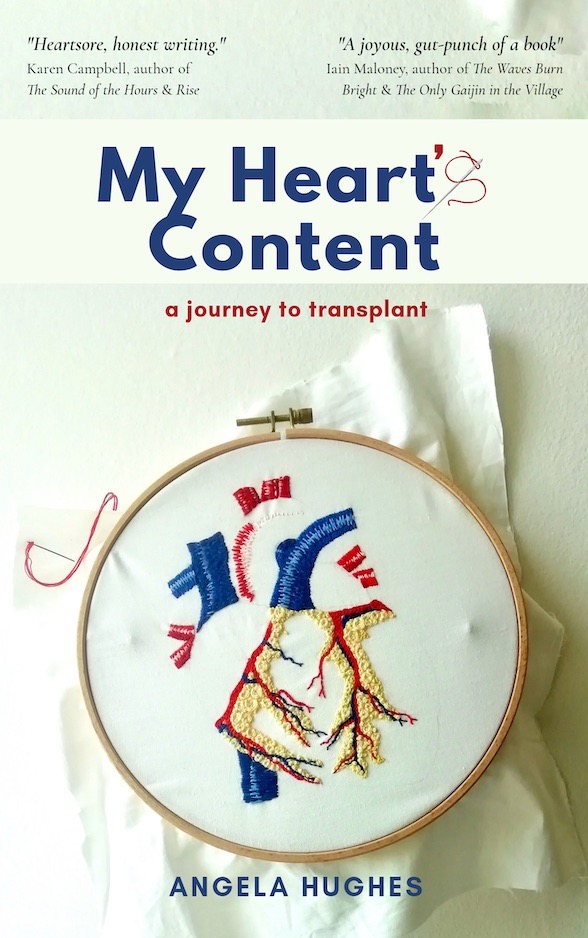
If you haven’t yet read My Heart’s Content and would like to do so, it’s available at: Liminal Ink

*Cover image for My Heart’s Content by Laura Donald

Organ donation: why it matters

This week, 7 – 13 September 2020, is organ donation week.

On Christmas Day 2013, I received the most incredible gift; a new heart. In order for that to happen, my donor made the decision to allow their organs to be used after their death. A decision they would have taken when they were fit and well. Their family agreed to honour that decision on Christmas Eve when they were neck-deep in grief. Their kindness and generosity of spirit saved my life. It is something neither I nor my family and friends will ever forget and for which we remain forever grateful.

In my family we are doubly grateful. I’m not the first to be saved through heart transplantation. Over a decade earlier my father received a new heart, his at Easter. We consider ourselves an extraordinarily lucky family.

Nothing can prepare you for the sheer magnitude of being told you need a heart transplant. The idea of my living, beating (albeit not that well) heart being cut out of my body and replaced with that of another, was way too much for me to contemplate for any length of time (still is). The awareness that in order for me to have a chance of survival, to have a future, someone else was denied theirs. It never leaves me.

The best way for me to honour the life of my donor is to live mine to the very best of my ability. Of course there will always be time when I get stressed, or annoyed, or short-tempered, or down. There are days when I feel fat, or my hair annoys me, or I can’t find anything to wear. For a while I struggled with these feelings; believed I was somehow doing a disservice to the memory of my donor. For a time I put myself under too much pressure to be happy all the time. But not anymore. Now I accept all feelings as being part of who I am. The trick is not to dwell and to keep moving forwards.

In March next year, the organ donation system in Scotland is due to change to a soft opt out. Instead of signing up to be an organ donor, the onus will be on people who do not want to donate their organs to opt out. The hope is more organs will be available. I used to shudder at the reference to ‘organs’ and not to the person. Organ donation will always be an emotive issue. The reality is, the living, breathing person the potential donor once was, is no more. They live on in memories and shared recollections, not in body parts they no longer have a use for. I understand now why it makes sense to separate the personal from the medical.

When I first had my transplant the thought of my donor’s family and friends grieving for their loss haunted me. I struggled with whether I was ‘worth’ my new heart. Over time, and with the help of members of my medical team and the transplant clinic at the Golden Jubilee Hospital, I came to terms with the fact that my donor’s death had nothing to do with me. It happened regardless of my need for a new heart. The decision of my donor to sign the organ donation register was what connected us. I think of that often and it makes me smile.

“… heart transplantation is the closest thing to a miracle.”

Last week, Paul and I premiered a video we made about our transplant journey with the Public Health, Private Illness conference. If you would like to watch it, you can do so using the link at the bottom of the page. The video is personal and it was difficult for both of us to relive our experience in this way. We did it because we feel strongly that we should play our part in raising awareness of heart transplantation and organ donation.

For me, heart transplantation is the closest thing to a miracle.

Everybody who receives a heart transplant would die without one.

Paul and I recorded the video below to share a wee snippet of our story and to help raise awareness of organ donation. It’s about 15 minutes long.

If you aren’t already, please consider signing up to be an organ donor.

In Scotland: https://www.organdonation.nhs.uk/uk-laws/organ-donation-law-in-scotland/

For the rest of the UK: https://www.organdonation.nhs.uk